Take-All Root Rot: The Disease That Makes St. Augustine Collapse Overnight - Copy
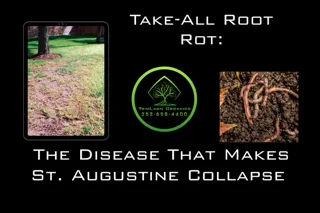
Take-All Root Rot: The Disease That Makes St. Augustine Collapse Overnight
Of all the lawn diseases you'll run into in this area, take-all root rot is probably the one that catches homeowners most off guard. A St. Augustine lawn can look mostly fine, maybe a little yellow, and then within a matter of weeks large sections of it just collapse. It feels sudden. It isn't. The damage has usually been building underground for a while before it ever shows up on top.

Why This One Is Different From Brown Patch or Large Patch
Brown patch and large patch attack grass blades and leaf sheaths, which is why you see circular brown patches fairly quickly once conditions turn favorable. Take-all root rot works differently. The fungus responsible, Gaeumannomyces graminis var. graminis, attacks the roots and stolons, the parts of the plant you can't see. By the time yellowing shows up above ground, the root system has often already sustained real damage. That lag is exactly why this disease gets misdiagnosed so often, mistaken for drought stress, nutrient deficiency, or chinch bug damage, all of which can look similar from a distance.
How to Spot It
Early yellowing. Affected areas take on a yellow-green cast rather than dying outright at first. This can look a lot like drought stress or a nitrogen deficiency, which is part of why it's easy to miss early.
Patches that expand. Left alone, yellow patches can grow to several feet across, sometimes more than ten, as the stolons connecting healthy and infected grass continue to die off.
The root check. This is the most reliable way to actually confirm it. Pull up a small section of grass at the edge of a suspect patch and look at the roots. Healthy roots are white or off-white and hold together. Roots affected by take-all root rot are brown to black, shortened, and often pull away from the stolon with almost no resistance.
Poor response to water and fertilizer. Because the problem is at the root level, watering more or feeding the lawn typically doesn't help, and can sometimes make things look worse rather than better.

What Sets the Conditions For It
Take-all root rot tends to show up under a specific combination of stress and environment: hot soil temperatures, generally in the upper 70s to high 80s, slow-draining or compacted soil, and soil pH above 6.5, since that's outside the range St. Augustine and the beneficial microbes around its roots prefer. On top of that, anything that stresses the plant already, herbicide injury, heavy shade, imbalanced fertility, or compaction, makes an infection more likely to take hold and spread.
Why Recovery Is Hard
This is the part that's genuinely frustrating about take-all root rot. Once it's established, recovery is slow and inconsistent, and simply laying new St. Augustine sod over a damaged area often fails, since the fungus is still present in the soil and the new sod can become infected the same way the old grass did. In more severe cases, real recovery means addressing the soil itself, not just the grass sitting on top of it.

What Actually Helps
Get the soil pH right. Since the disease favors higher pH, testing and adjusting toward the 5.5 to 6.0 range St. Augustine prefers removes one of the conditions the fungus needs.
Improve drainage. Poor drainage and compacted soil both favor infection, so aeration and addressing standing water matter more here than with most other lawn diseases.
Go easy on herbicides. Herbicide stress on St. Augustine specifically has been linked to higher take-all risk, so limit use to spot treatments only when truly necessary rather than routine applications.
Avoid pushing fast-release nitrogen. Heavy, quick-release fertilizer stresses the plant in ways that favor infection rather than helping it recover.
Reduce thatch and mowing stress. A thinner thatch layer and correct mowing height give roots a better environment to rebuild in.
None of these are overnight fixes. This is a soil-level problem, and soil-level problems take a full
season or more to turn around, even when everything is done correctly.
A Note on Grass Choice
If you've had a serious, recurring take-all problem in a St. Augustine lawn, it's worth knowing
that centipede has shown better resistance to this particular fungus. That's not a reason to panic
and rip out an otherwise healthy lawn, but it's a useful piece of context if you're renovating a
badly affected area and deciding what to replace it with.
When to Get a Second Opinion
Because the real damage happens underground and the above-ground symptoms overlap with
several other issues, this is one of the harder diseases to self-diagnose with confidence. If your
St. Augustine lawn is yellowing in a way that isn't responding to normal watering and feeding,
pulling a root sample and having someone experienced look at it is worth doing before you
spend more money guessing.
Take-all root rot is a root disease wearing a yellow lawn as a disguise. By the time it's visible, it's
already been active for a while, and fixing it means addressing soil conditions, not just what's
growing on top of them.