
Brown Patch vs. Drought Stress: How to Tell the Difference in Your Fescue Lawn - Copy
Brown Patch vs. Drought Stress: How to Tell the Difference in Your Fescue Lawn
If you have a tall fescue lawn in New Bern, and it is looking rough right now, it is easy to assume one thing every time. It is hot, it has not rained in a while, the lawn is thirsty. Sometimes that is exactly right. Other times what you are looking at is not thirst at all. It is a fungal disease called brown patch, and treating it like a watering problem can actually make it worse.
This applies specifically to fescue. Brown patch is a cool-season grass disease and does not affect centipede, zoysia, Bermuda, or St. Augustine. If your lawn is one of those warm-season grasses, a different set of issues is more likely behind any browning you're seeing this time of year.
Telling the two apart matters. Water a drought-stressed lawn and it recovers in days. Water a brown patch lawn the wrong way, especially in the evening, and you are feeding the exact conditions the fungus needs to spread.
What Brown Patch Actually Is
Brown patch is caused by a fungus called Rhizoctonia solani, and it's one of the most common diseases affecting tall fescue specifically. The fungus is present in soil pretty much everywhere. It stays dormant most of the year and activates when conditions line up: warm nights, usually above 60 degrees, high humidity, and grass blades that stay wet for extended periods. New Bern in July and August checks every one of those boxes on a regular basis, which is why fescue lawns here see it so reliably each summer.
How to Spot Brown Patch
Brown patch has a specific look once you know what to check for.
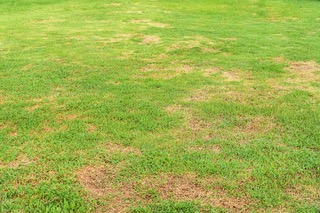
Shape. Roughly circular patches, ranging from a few inches to several feet across. As it spreads, patches can merge into irregular shapes.
The smoke ring. Early in the morning, when humidity is highest, you may see a thin ring of grayish purple, almost smoky-looking grass around the edge of an active patch. This ring disappears as the day dries out, so you have to catch it early.
Leaf lesions. Individual blades often show tan or straw-colored spots with a darker brown or reddish border, rather than the blade just drying out uniformly.
Where it shows up. Brown patch tends to appear in low spots, shaded areas, or anywhere air movement is poor, since those spots hold moisture longest.
How to Spot Drought Stress
Drought stress looks and behaves differently.
Shape. No real pattern. Stress shows up wherever soil dries fastest, often uniformly across sun-exposed areas, high spots, or thin soil zones, not in defined circles.
Color and texture. Grass takes on a dull, grayish-blue cast before it browns, and blades often fold or roll lengthwise to conserve moisture. This is different from the tan lesions of brown patch.
The footprint test. Walk across a drought-stressed lawn and your footprints stay visible for a while because the blades have lost the turgor pressure to spring back. This does not happen with brown patch.
Recovery speed. Water a drought-stressed lawn properly and you will usually see improvement within a few days. Brown patch does not respond that quickly to water alone, because the underlying issue is fungal, not moisture.
Why Getting This Right Matters
If you mistake brown patch for drought and respond with more frequent watering, especially in the evening, you extend the amount of time grass blades stay wet overnight. That is precisely the environment the fungus needs to keep spreading. You can end up making a small problem significantly worse while thinking you are helping. On the flip side, if you mistake drought stress for brown patch and hold back water out of caution, the lawn just keeps declining from lack of moisture with no disease to actually treat.
What To Do With Each One
For drought stress: water deeply, about one inch per week, delivered in one or two sessions rather than daily light watering. Early morning is best, so water reaches the roots before the day's heat causes evaporation.
For brown patch: the highest-leverage change is adjusting when and how you water. Irrigate early morning only, never in the evening, so blades dry out during the day. Avoid heavy nitrogen fertilization in summer, since lush new growth is exactly the tender tissue the fungus prefers. Improve air movement where you can, by pruning back shrubs or trees that shade and trap humidity over problem areas. An organic program that builds soil biology and root strength over time also gives the lawn more natural resistance heading into future summers, rather than just reacting to an active outbreak.
What About Mixed or Weedy Lawns?
Everything above assumes a fairly uniform fescue lawn, but a lot of yards aren't that clean. If your lawn is a mix of fescue, weeds, and whatever else has moved in over the years, brown spots get harder to read, because you're no longer looking at one plant responding to one cause.
A few things that commonly get mistaken for brown patch in a mixed or weedy lawn:
Weed dieback. Fast-growing annual weeds like crabgrass and foxtail turn brown and die back on their own schedule, not the fescue's. A patch that suddenly browns out in a shape that doesn't match your mowing pattern is worth a close look before you assume disease.
Dog urine. Nitrogen-burned spots from pet urine tend to have a brown or dead center with a ring of darker, greener grass around the edge, a pattern brown patch doesn't produce.
Uneven thatch or compaction. In a mixed lawn, different areas often have different thatch and soil density built up over years of uneven care, so some patches simply hold water and nutrients worse than others regardless of disease.
Grub or insect damage. Sections of dead turf that lift or pull up easily, almost like loose carpet, point to root-feeding insects rather than a fungal issue
The honest answer for a mixed or weedy lawn is that a look from the porch usually isn't enough to tell these apart, since several causes can produce a similar brown patch at the same time of year. This is the situation where getting someone to actually walk the yard and check what's underneath the brown spot, not just assume the two options above, pays off the most.
When to Get a Second Opinion
Brown patch and drought stress can occasionally overlap, and gray leaf spot, a different fungal disease, can look similar enough to confuse the two even further. If you are looking at your lawn and genuinely cannot tell which one you are dealing with, that uncertainty alone is a good reason to get an experienced set of eyes on it before you spend money treating the wrong problem.
The fix for drought stress and the fix for brown patch are almost opposites in one important way: how and when you water. Getting the diagnosis right first is what makes the treatment actually work, instead of accidentally making things worse.